Using brain scans, acupuncture and the nasty stuff that puts the sting in pepper spray, researchers are learning how placebos play out in our brains.These innocuous medications - long used as decoys in clinical drug trials - aren't supposed to have real chemical effect on the body.
But experience over the years has taught doctors that some patients who take placebos experience real relief.Now brain scans show that when test subjects think a placebo is a real medication or treatment, the expectation of relief can release natural painkillers. That, in turn, can ease the discomfort of ailments from overworked muscles to a stinging hand.
[ more ]


Dec 5, 2006
Conscious Machine
Can we ever build such a device? This was discussed at the debate and a lecture that followed MIT's celebration of the 70th anniversary of Alan Turing's paper "On Computable Numbers" which was published in 1936...
[ more ]
[ more ]
Nov 29, 2006
Next 50 years in science
What will be the biggest breakthrough of the next 50 years? In the last weeks issue of New Scientist, this question was asked to over 70 of the world's most brilliant scientists for their ideas.
[ more ]
[ more ]
Nov 27, 2006
Neural signature of bilingualism
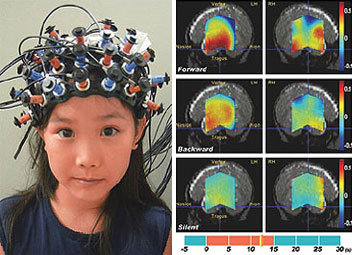
 Researchers have found areas in the brain that indicate bilingualism using NIRS. The finding sheds new light on decades of debate about how the human brain's language centers may actually be enhanced when faced with two or more languages as opposed to only one. The study was presented at the Society for Neuroscience's annual meeting on October 14-18 in Atlanta, Ga.
[ more ]
Nov 25, 2006
Hitachi Brain Computer Interface
 Hitachi has reportedly created and successfully tested an interface that allows users to turn a power switch on and off by using their brain only (Japanese)(English).
Optical topography, a neuroimaging technique which measures the changes in blood hemoglobin concentration in parts of the brain responsible for mental activity, is utilized with Hitachi's brain-controlled interface.
Any significant changes monitored in the brain blood flow is then translated into voltage signals that are used for activating the model train's power switch.
[ more ]
Nov 20, 2006
WinXP patch for improving battery life using USB devices
Near Infrared for Examining Coronary Arteries
Nov 6, 2006
Implanted chip modifies pathways in brain
Researchers at the University of Washington (UW) are working on an implantable electronic chip that may help establish new nerve connections in the part of the brain that controls movement. Their most recent study, published in the Nov. 2, 2006 edition of Nature, showed such a device can induce brain changes in monkeys lasting more than a week. Strengthening of weak connections through this mechanism may have potential in the rehabilitation of patients with brain injuries, stroke, or paralysis.
Oct 10, 2006
Clinical trial for ECoG based BCI
A 14-year-old who suffers from epilepsy, is the first teenager to play a two-dimensional video game, Space Invaders, using only the signals from his brain to make movements. The teenager had a grid atop his brain to record brain surface signals, a brain-computer interface (BCI) technique that uses electrocorticographic (ECoG) activity - data taken invasively right from the brain surface. It is an alternative to a frequently used technique to study humans called electroencephalographic activity (EEG) - data taken non-invasively by electrodes outside the brain on the scalp. The results were encouraging. The teenager could pass the level 1 easily learned instantaneously...
[ more ] [ video ]
[ more ] [ video ]
Oct 3, 2006
Foot activated user interface

We are still in the early ages of Brain Computer Interfaces (BCI) though there are recent achievements. Meanwhile, researchers at HP are working on alternative communication devices and come up with a foot-activated user interface that can bring mousing abilities to those without hands / arms (or a suitable amount of dexterity). Although this solution is not the ultimate human computer interface, it is a progress in the right direction and useful to many before we have neural based mature BCIs.
Within the device, a magnetic sensor is affixed to one foot, while a transmitter emitting "pulsed magnetic signals" is clipped onto the other, and as the pulsating foot wiggles about, the relative distance and position is calculated and converted into cursor movements on screen. The designers have suggested that "twists" could be understood as "right / left clicks," while "sliding atop the ground" could be translated as "dragging and dropping."
[ patent ] [ more ]
[ patent ] [ more ]
Subscribe to:
Comments (Atom)